In the hyper-competitive cycling market, leading brands know that performance eyewear is not an accessory; it is technical equipment critical to performance. For product managers, sourcing agents, and private label brand owners, sourcing this equipment from a qualified eyewear manufacturer requires a deep, technical understanding that goes far beyond aesthetics. It demands a mastery of material science, optical physics, and a robust supply chain strategy.
This guide is structured for the professional buyer, providing the in-depth knowledge required to partner with an OEM/ODM cycling eyewear supplier and engineer a market-leading product line. We will deconstruct the components, technologies, and supplier qualifications, integrating answers to the most pressing questions that expert wholesale cycling sunglasses buyers are asking today.
The Foundation: Engineering for Impact Safety and Optical Clarity
Before any discussion of tints or REVO coatings, a performance lens from any reputable cycling glasses factory must fulfill two primary duties: protecting the rider’s vision and delivering a flawless optical experience.
How to choose cycling sunglasses for eye protection: The Non-Negotiables
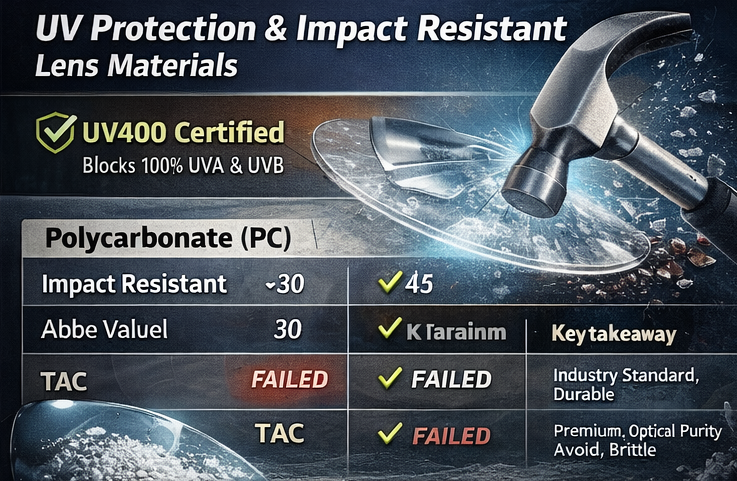
Eye protection is a baseline requirement, defined by UV radiation absorbance and certified impact resistance—key points for any factory audit checklist.
UV Protection (UV400 Standard): “UV400” certifies that the lens blocks 100% of all ultraviolet light up to 400 nanometers. For performance eyewear, this is a prerequisite. With superior materials like Polycarbonate and Trivex, this protection is inherent to the polymer itself, not a coating that can wear off. This guarantees permanent protection and is a key specification for any bulk order sports eyewear.
Impact Resistance (ANSI Z87.1+): This American National Standard is the benchmark for safety. The “+” designation is critical, certifying the eyewear has passed high-velocity impact tests. Sourcing ANSI Z87.1+ certified eyewear is the only way to responsibly protect riders and is a primary question for any potential sport sunglasses OEM partner.
The choice of lens material is therefore the first and most critical engineering decision when working with a polycarbonate lens manufacturer.
| Material | Impact Resistance (ANSI Z87.1+) | Optical Clarity (Abbe Value) | Key Sourcing & Engineering Takeaway |
| Polycarbonate (PC) | Passes. The industry benchmark; the go-to choice for any impact resistant lens supplier. | Good (30). The established standard for performance sport applications worldwide. | The workhorse for performance eyewear OEM manufacturing; offers the best intersection of safety, manufacturability, and cost-efficiency. |
| Trivex | Passes. Superior impact resistance and 10% lighter, offered by premium eyewear suppliers. | Excellent (45). Offers optical purity comparable to crown glass. | The premium choice for high-end lines or prescription cycling glasses (RX) where optical perfection is a key selling point. |
| TAC (Triacetate Cellulose) | Fails. Brittle material unsuitable for performance applications. | Moderate (30). Relies on laminated films for polarization, creating potential for delamination. | Avoid for performance lines. A low-cost option for casual/promo sunglasses, but not for a serious private label cycling glasses program. |
Mastering the Environment: Advanced Lens Technologies & Coatings
With safety established, the next level of product engineering focuses on manipulating light and managing environmental challenges, key differentiators for your brand.
Polarized vs photochromic lenses for cyclists: A Technical Comparison
This is a choice dictated by the target rider and environment. When discussing with your eyewear factory, specify the intended use case.
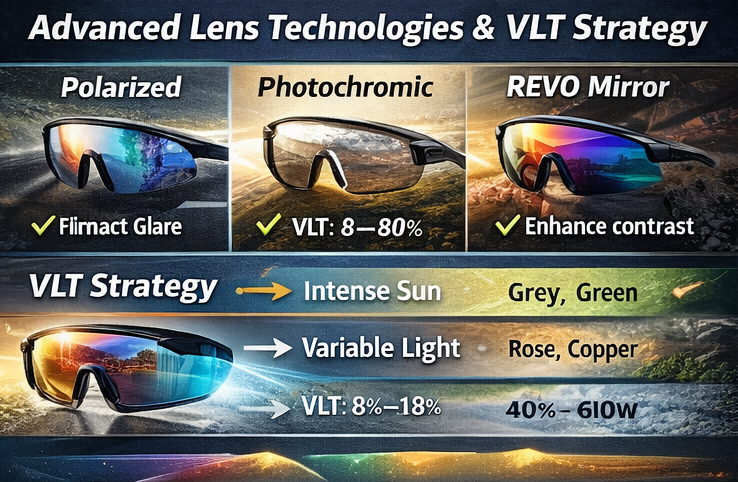
1. Polarized Lenses use a laminated filter to block horizontal glare. They are highly effective but have known drawbacks for some cyclists, including difficulty reading LCD screens.
- Best Sourcing For: Road cycling sunglasses lines targeting regions with consistently bright sun.
2. Photochromic Lenses use molecules that react to UV radiation, automatically adjusting the lens tint. Modern photochromic lens technology is a key feature for premium products.
- Best Sourcing For: MTB Goggles, gravel bike eyewear, and all-around performance models where light conditions are variable. When qualifying a photochromic lens factory, demand data on transition speed and temperature stability.
Best cycling glasses for different light conditions: VLT Strategy
A sophisticated product line, especially one featuring sunglasses with interchangeable lenses, should offer options covering all conditions. Specify VLT (Visible Light Transmission) targets with your supplier to create custom lens tints.
| Light Condition | VLT Range | Recommended Base Tint | Technical Purpose & Sourcing Focus |
| Intense Sun 8% – 18% | 8% – 18% | Grey, Green | Focus on neutral color perception. A perfect application for a dark REVO mirror coating. |
| Overcast / Variable | 20% – 40% | Rose, Copper | Specify a contrast-enhancing lens to make terrain features “pop.” |
| Low Light / Forest | 40% – 80% | Yellow, Clear | Sourced for protection and minimal light reduction. |
Engineering Interchangeable Lens Systems: A Key Feature
For a comparison of cycling sunglasses with interchangeable lenses, the quality of the mechanism is what separates premium from poor products. During your supplier evaluation, stress-test the security, ease of use, and long-term durability of the interchange system.
Sourcing Cycling Glasses with UV Protection and Anti-Fog Features
While UV protection is a given, managing fog requires specific tech. Ask your ODM eyewear partner about their anti-fog solutions:
- Anti-Fog Coating for Glasses: Inquire about the durability and longevity of their interior hydrophilic coatings.
- Frame Ventilation: Analyze the design of vents in the frame—this demonstrates a factory’s R&D capabilities.
The Chassis: Sourcing Durable and Lightweight Frames
The frame is the delivery system for your optical technology. Material choice is critical.
How to choose the right cycling glasses for mountain biking: Frame Focus
For the demanding MTB eyewear market, the frame must deliver maximum coverage, an unshakable grip (achieved with hydrophilic rubber components), and superior ventilation. These are key design elements to specify in your custom cycling glasses brief.
Where can I find durable cycling glasses for road biking: Material is Key
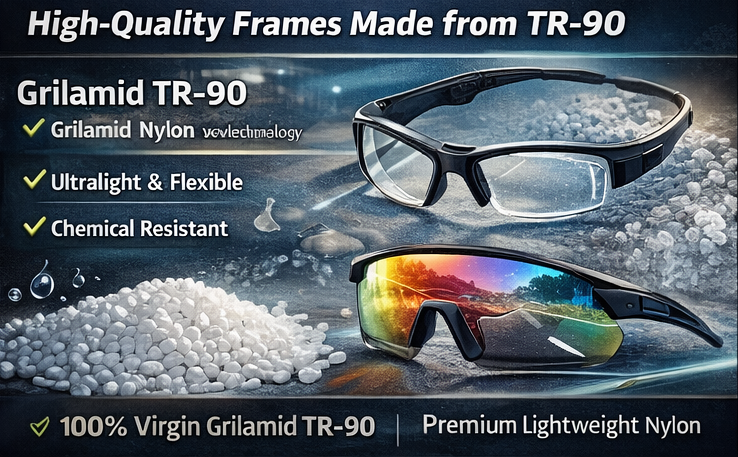
Durability is a direct function of frame material. The undisputed gold standard for any high-end sport sunglasses supplier is Grilamid TR-90.
- Why TR-90 is the Benchmark: Its resistance to chemicals (sunscreen, sweat), exceptional flexibility, and shape memory make it the premier material. When creating custom frame molds, TR-90 allows for designs that are both strong and incredibly light.
Specify “100% Virgin Grilamid TR-90” with your TR90 frames supplier to ensure you are sourcing the highest quality, not a cheaper, less durable blend. This defines a truly lightweight cycling glasses frame.
2026 Design & Technology Trends: Engineering for the Future Rider
Staying ahead of market trends is essential for brand relevance and capturing market share. A professional buyer must not only understand current technology but also anticipate the needs of the future rider. Here are the dominant trends to build into your 2026 product development roadmap.
The RX Imperative: Capturing the Prescription Market
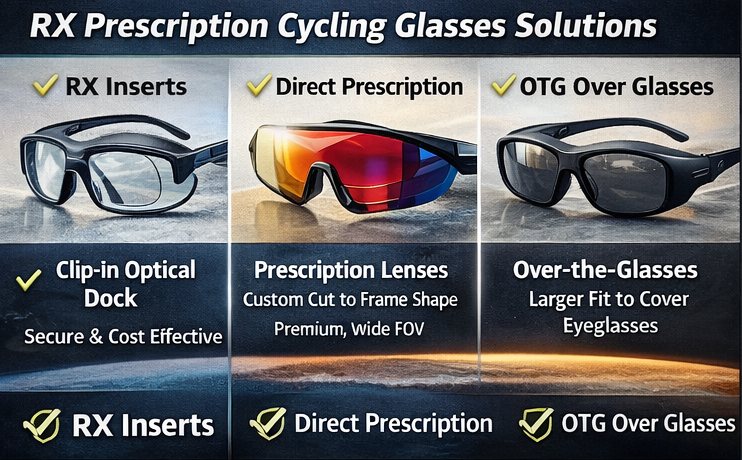
A significant and growing demographic of cyclists requires vision correction, presenting a massive opportunity for brands that offer viable solutions. Sourcing “RX-able” eyewear is no longer a niche; it is becoming a mainstream requirement. Your eyewear supplier must demonstrate capability in one or more of the following systems:
1. Solution A: Cycling Glasses with RX Inserts (Optical Docks): This is the most common and versatile solution. A small, separate frame—the RX insert or optical dock—is glazed with the user’s prescription by their local optician and then securely clips in behind the main shield lens.
- Sourcing Focus: When vetting a prescription sports eyewear supplier, demand samples of their rx insert systems. Evaluate the security of the clip mechanism, the quality of the insert material, and the ease of installation. This is the most cost-effective way to offer prescription cycling glasses capability across an entire product line.
2. Solution B: Direct In-Frame Prescription: This premium solution involves creating custom prescription sports eyewear where the corrective lens is cut to the exact shape of the frame itself. This is common in dual-lens (non-shield) designs.
- Sourcing Focus: This requires a supplier with advanced lens-cutting (edging) capabilities. It offers a superior user experience (wider field of view, no extra layer to fog up) but at a higher cost and is limited to less complex frame shapes. This is a key offering for a high-end RX cycling sunglasses program.
3. Solution C: Over-the-Glasses (OTG) Models: This involves designing frames with a larger chassis and temple cutouts specifically to be worn over a user’s regular prescription glasses.
- Sourcing Focus: While a smaller niche, cycling glasses over glasses provide a simple, non-optical solution for a specific user base. Evaluate the comfort and stability of the fit when worn over a range of common eyeglass frame sizes.
Hyper-Lightweight & Minimalist Frames
The “grams matter” ethos is a powerful marketing and performance driver.
- Trend: The pursuit of ultra lightweight cycling glasses (sub-25 grams) is leading to more minimalist designs.
- Sourcing Focus: Look for suppliers with expertise in frameless cycling sunglasses and rimless cycling glasses. These designs require high-precision drilling and mounting of temples and nose pieces directly onto the polycarbonate shield, demanding a higher level of manufacturing accuracy.
Sustainability as a Core Feature
Eco-conscious consumers are an influential and growing market segment.
- Trend: The use of sustainable and recycled materials is becoming a key differentiator.
- Sourcing Focus: Inquire about your supplier’s capabilities with bio-based polymers like Arkema’s Pebax® Rnew® (derived from castor beans) or frames made from recycled fishing nets and other post-consumer plastics. Highlighting this in your marketing can add significant brand value.
Sourcing Intelligence: Vetting Partners and Your Supply Chain
Benchmarking Against Top Brands to Define Your Niche
The best cycling eyewear brands for road biking (Oakley, 100%, etc.) set the standard. Analyze their use of high-grade materials and proprietary lens tech to inform your own product strategy and positioning as a premium private label eyewear brand.
Where to buy cycling glasses online with fast shipping: A B2B Perspective
For a brand, this question translates to: “How do I find a reliable cycling glasses manufacturer in Asia?” Whether it’s a China cycling glasses factory or a Taiwan eyewear manufacturer, a dependable supply chain is defined by:
Vertical Integration: Look for factories that control the entire process.
Vertical Integration: Look for factories that control the entire process.
Logistical Expertise: The ability to provide clear, accurate quotes and timelines for wholesale cycling sunglasses orders via both sea and air freight.
This is the foundation of a successful, long-term partnership when you import cycling glasses. It ensures you can consistently deliver a high-quality product to your market.