The conversation around environmentally friendly glasses has shifted from whether they can be produced at scale to whether they can deliver the same daily reliability and financial viability as their conventional counterparts. In procurement discussions, two questions now dominate: does a frame made from alternative inputs hold up under repeated wear, and does the unit economics make sense across the supply chain? We have spent considerable time examining both dimensions, and the answers are more nuanced than a simple yes or no.
Eco-Friendly vs Conventional Eyewear: Quick Answer
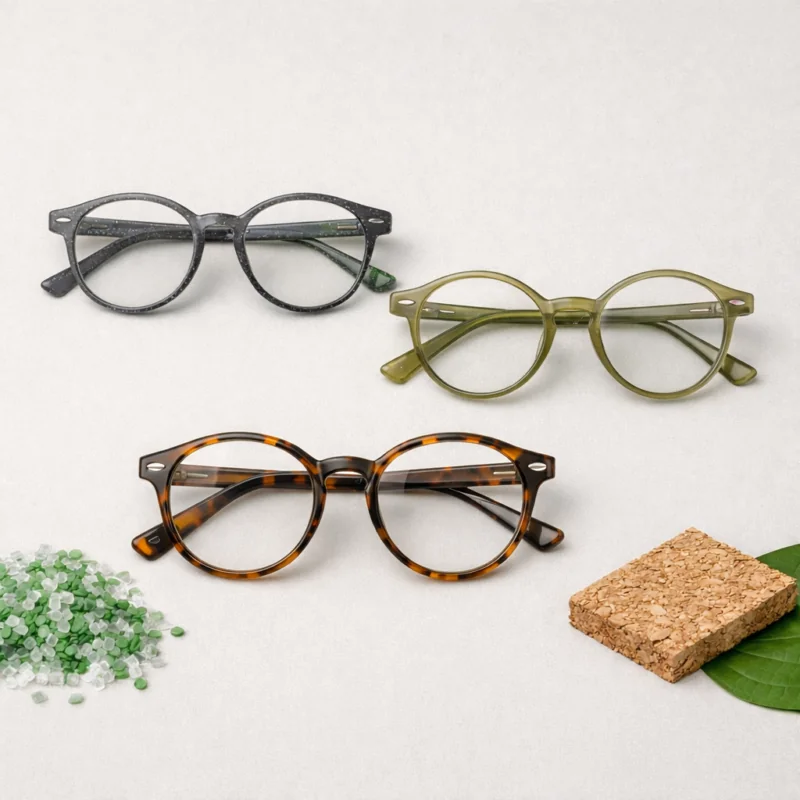
Eco-friendly eyewear can now deliver durability comparable to conventional frames when the material and manufacturing process are properly selected. Bio-acetate and recycled stainless steel are suitable for premium and optical collections, while bio-based polyamide works well for flexible sports and children’s eyewear. Recycled PET provides a lighter, cost-conscious option for fashion and promotional collections.
For eyewear buyers, the main differences are usually material cost, certification requirements, minimum order quantities, tooling requirements and the sustainability goals of the collection—not simply frame durability.
What We Mean by Durability in Frame Engineering
Durability in eyewear is not a single property. It is a composite of tensile strength, hinge‑cycle endurance, resistance to deformation under heat, surface hardness, and long‑term colour stability. When we evaluate environmentally friendly glasses, we test them against the same criteria we use for any frame entering our range.
Bio‑acetate, the most widely adopted substitute for petroleum‑based cellulose acetate, illustrates this point clearly. Its molecular backbone still consists of wood pulp and cotton fibre, but the plasticiser component has been reformulated using plant‑derived chemistry rather than phthalate‑based additives. The technical data we have reviewed shows that hardness‑enhanced grades of bio‑acetate achieve greater rigidity than standard acetate while retaining enough flexibility to survive repeated adjustments without micro‑cracking. Independent durability testing confirms that bio‑acetate frames offer comparable strength and longevity to traditional high‑quality acetate, and that they can be heat‑adjusted, re‑polished, and serviced multiple times before reaching end of life. With routine care, we see bio‑acetate frames serving wearers for five years or more, a figure in line with conventional acetate products.
Reclaimed metal alloys follow a similar pattern. Stainless steel produced from scrap feedstock, with recycled content regularly exceeding 80 or even 90 percent of the total mass, retains full corrosion resistance and fatigue performance. The electric‑arc furnace route used to melt this scrap now commonly runs on renewable electricity in several European supply chains, which further reduces the embedded carbon without altering the metal’s grain structure. The inherent resilience of stainless steel means these frames maintain their shape and hinge function over thousands of open‑close cycles, a performance metric indistinguishable from virgin‑alloy equivalents.
Castor‑oil‑derived polyamides occupy a different position on the durability spectrum. These thermoplastics exhibit high impact resistance, dimensional stability, and controlled elasticity, properties that make them particularly suited to injection‑moulded sport and children’s frames where repeated flexing and occasional drops are expected. Because the material does not splinter under mechanical load, it performs well in safety‑relevant applications. At JHEYEWEAR, our eco‑friendly collection includes frames built from this class of bioplastics, and the return‑rate data we have collected suggests reliability on par with petroleum‑based nylon.
Recycled PET frames, often manufactured from discarded water bottles processed into food‑grade pellets, present a slightly different profile. Their surface hardness sits below that of premium acetate, but the material compensates with a weight advantage and corrosion‑free behaviour. For fashion‑forward styles where the replacement cycle is shorter by design, this durability envelope is entirely adequate.
Cost Structures Across the Supply Chain
Pricing for environmentally friendly glasses reflects a set of structural factors rather than a simple premium over conventional production. The raw‑material cost for bio‑acetate sheet currently runs above that of standard acetate, partly because of smaller batch volumes and partly because of the additional processing required to achieve certified bio‑based content. A typical bio‑acetate formulation contains around 65 percent bio‑derived carbon compared to the roughly 40 percent found in standard acetate, and the testing and certification that substantiate that figure add incremental expense. Industry data suggests that sustainable material inputs can increase production costs by 20 to 30 percent relative to conventional equivalents at the factory gate.
However, that factory‑gate figure does not capture the full economic picture. Waste‑reduction programmes that accompany sustainable manufacturing often shrink material and disposal costs by around a quarter per unit, effectively offsetting a portion of the input premium. In metal‑frame production, closed‑loop systems achieve a recycling rate of 98 percent for off‑cuts and rejected parts, turning what would be a scrap‑disposal cost into reusable feedstock.
Injection‑moulded designs add another layer of complexity to the cost equation. The mould investment, typically USD 2,000 or more per design, requires production quantities of at least 1,200 pieces per model to amortise economically. For bio‑based polyamide frames, the per‑unit cost at scale can approach that of conventional injection plastics, provided the order volume supports the tooling spend. For smaller boutique runs, unit costs remain higher.
What we find significant in our own sourcing is that the price gap has been narrowing steadily over the past three years. The global bio‑based glasses market reached an estimated USD 315 million in 2024 and is projected to grow at a compound annual rate of around 7.8 percent through 2031. That volume growth is driving economies of scale at the material‑supply level, and several of the sheet suppliers we work with have reduced their minimum order quantities significantly since 2022. Environmentally friendly glasses that once required premium pricing are now entering mid‑market wholesale brackets with increasing frequency.
Where the Two Intersect
When we map durability against cost, a practical framework emerges for procurement decisions. Bio‑acetate frames fall into the mid‑to‑upper wholesale range but deliver a lifespan and serviceability that makes the cost‑per‑wear calculation broadly comparable to traditional acetate when amortised over several years. Recycled stainless steel sits in a similar band: the initial outlay can be slightly higher than virgin metal, but the corrosion resistance and potential for infinite recyclability reduce long‑term replacement frequency.
Castor‑oil polyamides offer a material cost that becomes competitive at volume, with mechanical properties that reduce breakage‑related returns. Recycled PET occupies the value segment, enabling sustainable entry points for price‑sensitive retail channels without compromising on the environmental message.
Eco-Friendly Eyewear Material Comparison for Buyers
| Material | Durability | Cost Position | Best Suited For | Key Sourcing Consideration |
|---|---|---|---|---|
| Bio-acetate | High | Mid to premium | Optical frames, sunglasses, fashion eyewear | Material certification and sheet availability |
| Recycled stainless steel | High | Mid to premium | Optical and metal frames | Recycled-content traceability |
| Bio-based polyamide | High impact resistance | Competitive at volume | Sports, flexible and children’s eyewear | Tooling cost and production volume |
| Recycled PET | Moderate | Value to mid-range | Fashion and promotional eyewear | Surface finish and design requirements |
| Conventional acetate | High | Mid-range | Optical and fashion frames | Mature supply chain and broad material availability |
| Virgin stainless steel | High | Mid-range | Optical and metal frames | Established manufacturing process |
The best material therefore depends on the buyer’s target price, expected order volume, frame design, certification requirements and sustainability objectives. There is no single sustainable material that is optimal for every eyewear project.
What We Have Observed
The earlier assumption that sustainable frames must sacrifice quality or affordability no longer holds against the data we see in daily operations. The durability of today’s environmentally friendly glasses meets the standards required for optical retail, and the cost differential has compressed to the point where procurement choices are increasingly driven by certification requirements and consumer expectations rather than budget constraints alone. We view this convergence as evidence that material innovation in the eyewear industry has reached a level of maturity where ecological responsibility and commercial pragmatism can coexist without one undermining the other.
FAQ: Sourcing Eco-Friendly Eyewear
Are eco-friendly eyewear frames as durable as conventional frames?
They can be. Bio-acetate, recycled stainless steel and bio-based polyamides can provide durability suitable for commercial eyewear when the appropriate material grade, frame design and manufacturing process are used.
Are sustainable eyewear materials more expensive?
Some sustainable materials carry a higher raw-material cost than conventional alternatives. However, the final difference depends on material type, order quantity, tooling, certification and production method. At sufficient production volumes, some bio-based injection materials can become more cost competitive.
What materials can be used for sustainable eyewear?
Common options include bio-acetate, recycled acetate, recycled stainless steel, recycled plastics such as rPET, and bio-based polymers. The appropriate choice depends on whether the product is an optical frame, sunglass, sports frame or fashion collection.
What should buyers check when sourcing eco-friendly eyewear?
Buyers should verify the actual material composition, supplier documentation, traceability, applicable certifications, production consistency and whether sustainability claims can be supported by documentation.
Can eco-friendly eyewear be customized through OEM or ODM production?
Yes. Sustainable materials can be incorporated into OEM and ODM eyewear projects, including custom frame designs, colors, logos, lenses and packaging. Material selection should be confirmed early because it can affect tooling, MOQ, cost and production lead time.
Does JHEYEWEAR manufacture eco-friendly eyewear?
Yes. JHEYEWEAR is a China eyewear manufacturer providing OEM, ODM and private-label production for international eyewear buyers. Sustainable material options include recycled and bio-based materials for different eyewear applications, with material selection depending on the design, order volume and target market.
Can JHEYEWEAR provide GRS-certified recycled material options?
JHEYEWEAR holds Global Recycled Standard (GRS) certification and can support eyewear projects requiring traceable recycled-material solutions. Buyers should confirm the specific material, certification scope and documentation requirements with the factory before production.