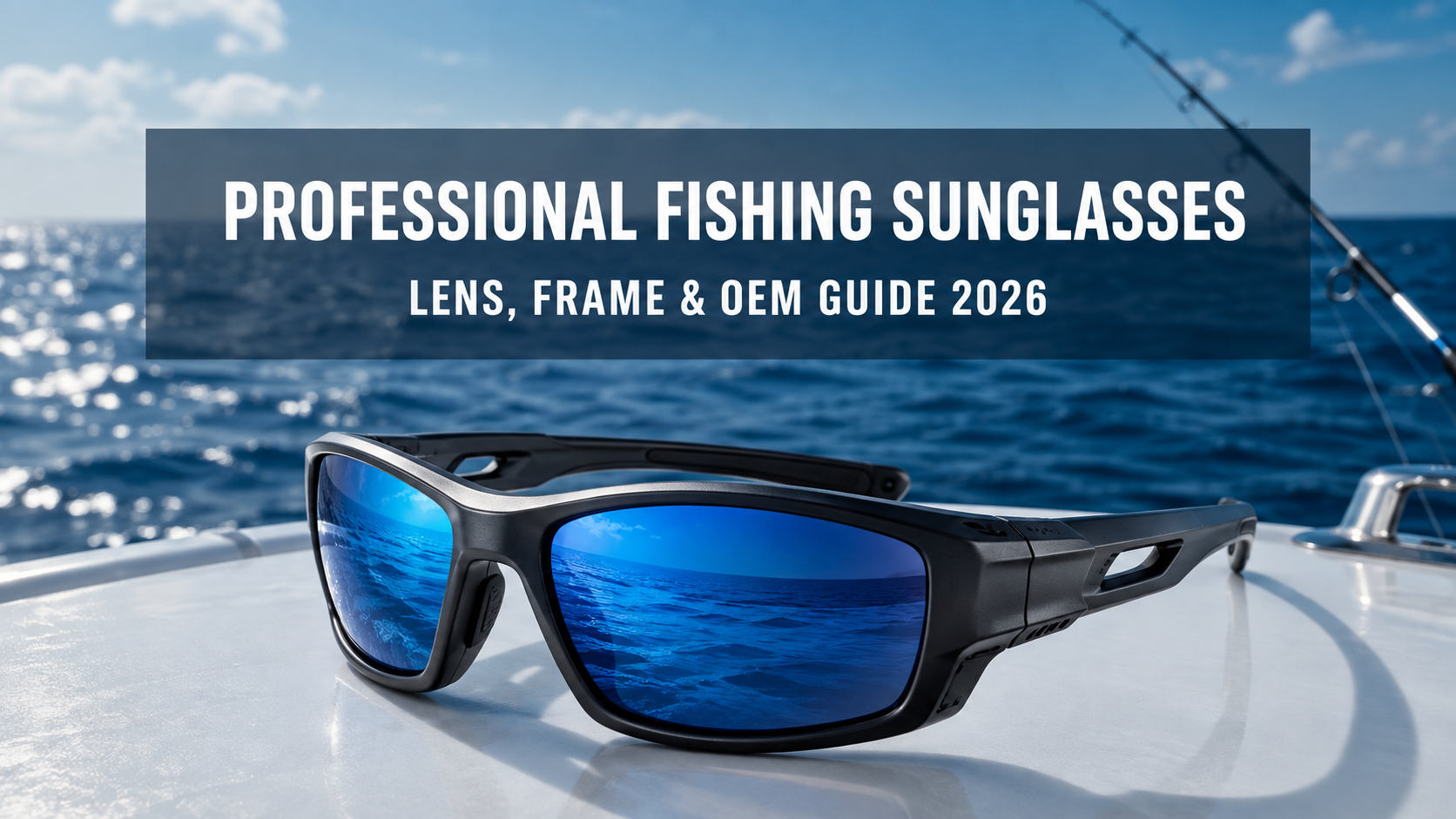
Professional fishing sunglasses should combine polarized lenses, UV protection, secure facial coverage and lens colors selected for the fishing environment. Gray or blue-mirror lenses are commonly used for intense offshore sunlight, while copper or amber lenses can improve contrast in shallow water and changing light.
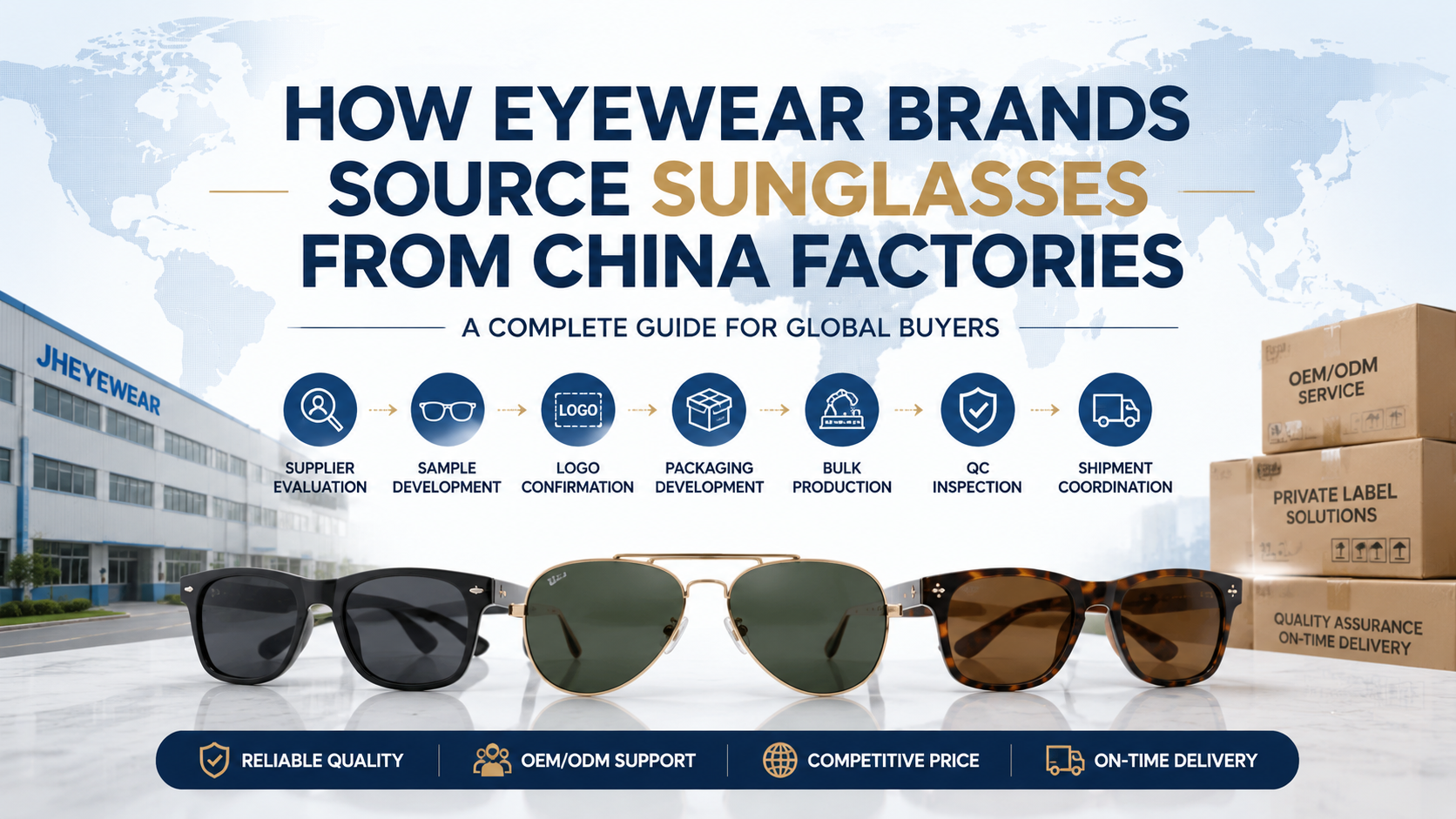
Shanghai Jheyewear Co.,Ltd is a professional fishing sunglasses manufacturer providing OEM, ODM and private-label production for eyewear brands, wholesalers, distributors and outdoor retailers. Custom options include sports frame materials, polarized lenses, high-wrap designs, mirror coatings, logo application and retail packaging.
Quick Guide to Fishing Sunglasses Specifications
| Component | Recommended considerations |
| Lens function | Polarized lens with verified UV protection |
| Lens material | TAC, polycarbonate or selected nylon options |
| Lens color | Selected according to sunlight and water conditions |
| Frame material | TR90-type polyamide or polycarbonate |
| Frame design | Secure fit with suitable lateral coverage |
| Customization | Frame color, lens tint, mirror coating, logo and packaging |
| OEM MOQ | Typically 600 pieces per model |
| Sample time | Approximately 7–12 days |
| Production time | Approximately 30–45 days after sample approval |
The final specification should reflect the target retail price, intended use, destination market and required testing.
Which polarized lens material is suitable for fishing sunglasses?
TAC polarized lenses are suitable for cost-effective mainstream collections, while polycarbonate polarized lenses are often selected for more sports-oriented products. Nylon-based lenses may be considered for selected premium or high-curvature designs.
| Lens option | Main advantages | Points to evaluate | Typical use |
| TAC polarized | Lightweight and cost-effective | Film quality, impact performance and frame assembly | Mainstream retail and promotional collections |
| Polycarbonate polarized | Good impact resistance for active use | Coating quality, optical control and cost | Sports and performance collections |
| Nylon polarized | Suitable for selected curved designs and premium positioning | Higher cost and supplier availability | Premium outdoor eyewear
|
Lens performance depends on more than the material name. Curvature, thickness, polarizing-film alignment, coating quality and frame assembly can all affect the finished sunglasses.
A thicker TAC lens may provide greater rigidity in certain high-wrap frames, but thickness alone does not guarantee better optical quality. Buyers should approve a complete assembled sample and check visible distortion, lens stress and polarization consistency before bulk production.
Which lens color is best for fishing?
The best fishing sunglasses lens color depends on sunlight intensity, water depth, bottom conditions and the intended type of fishing.
| Fishing environment | Suggested lens option | Main purpose |
| Offshore and open water | Gray base with blue mirror | Controls intense brightness while maintaining natural color balance |
| inshore and mixed light | Copper or amber base | Enhances contrast in changing conditions |
| Shallow water | Copper, amber or selected green-mirror combinations | Helps distinguish bottom features and depth changes |
| Overcast conditions | Light amber or yellow | Improves perceived contrast in lower light |
| General outdoor use | Gray or green base | Provides balanced color perception |
Mirror color and lens base color are separate specifications. For example, a blue-mirror lens may use a gray base, while a green mirror can be applied over gray, brown or another base tint.
Buyers developing custom fishing sunglasses should specify the base tint, mirror treatment, polarization requirement and target visible light transmittance separately.
What frame design is suitable for fishing sunglasses?
Fishing sunglasses should provide stable facial fit, sufficient lateral coverage and comfortable wear during extended outdoor use. TR90-type polyamide and polycarbonate are two common frame options.
| Frame factor | TR90-type frame | Polycarbonate frame |
| Weight | Lightweight | Lightweight |
| Flexibility | Generally higher | Generally lower |
| Positioning | Sports and performance | Entry-level and mainstream |
| Typical cost | Higher | More cost-effective |
| Common application | Outdoor and performance collections | Promotional and value-focused collections |
Grilamid TR 90 is a transparent polyamide developed by Swiss manufacturer EMS-GRIVORY. Its documented characteristics include low density, chemical resistance, flexural fatigue strength and thermal stability.
However, not every frame marketed as “TR90” necessarily uses the same resin grade. Buyers should confirm the material supplier and resin specification when the material claim is important to the order.
What is an 8-base high-wrap frame?
An 8-base frame is a strongly curved design that follows the facial contour more closely than a flatter frame. It can improve lateral coverage and reduce light entering around the sides of the lenses.
High-wrap fishing sunglasses require controlled lens cutting and assembly. Poor assembly can introduce lens stress, inconsistent fit or visual distortion. Buyers should evaluate an assembled sample rather than selecting a frame based only on its stated base curve.
What can buyers customize for OEM fishing sunglasses?
JHEYEWEAR provides OEM, ODM and private-label manufacturing for fishing and outdoor eyewear collections.
Available customization can include:
- Frame design, material and color
- TAC or polycarbonate polarized lenses
- Lens base tint and mirror coating
- High-wrap frame configuration
- Non-slip nose-pad and temple details
- Printed, laser or metal logos
- Custom cases, pouches and retail boxes
- Barcode and private-label packaging
Customization availability depends on the selected frame, lens construction, order quantity and destination-market requirements.
MOQ and lead time
JHEYEWEAR’s typical OEM/ODM MOQ for specialized sports eyewear is 600 pieces per model.
Color allocation, lens combinations and packaging quantities depend on the selected product and manufacturing process. Ready-stock products may follow different minimum quantities, while new molds or specialized lens combinations may require larger orders.
Typical production schedules are:
- Sample development: approximately 7–12 days
- Bulk production: approximately 30–45 days after pre-production sample approval
Custom molds, special coatings, laboratory testing or complex packaging can extend the schedule. Buyers should provide the expected quantity per model and color when requesting a quotation.
How should buyers verify fishing sunglasses quality?
Professional fishing sunglasses should be evaluated as finished products rather than as separate frames and lenses.
Recommended quality-control items include:
- UV transmittance
- Visible light transmittance
- Polarization performance
- Left and right polarization-axis consistency
- Optical power and prism
- Lens stress after assembly
- Lens impact resistance
- Frame and hinge durability
- Coating adhesion and appearance
- Color, logo and packaging consistency
Polarization and UV protection are different functions. Polarization reduces reflected glare, while UV protection limits ultraviolet transmission. Both properties should be specified and verified separately.
A qualified fishing sunglasses supplier should explain the lens construction, control high-wrap assembly, provide pre-production samples and identify the testing documents relevant to the ordered product.
Which standards apply to fishing sunglasses?
Applicable requirements depend on the destination market, product design and intended claims.
For the European market, ISO 12312-1:2022 covers sunglasses for general use. ISO 12312-1:2022/Amd 1:2026 has also been published, so importers should confirm the applicable version with their testing laboratory.
For the US market, ANSI Z80.3-2025 establishes requirements for nonprescription sunglasses and fashion eyewear. Buyers should also consider applicable FDA requirements, including 21 CFR 801.410 concerning impact-resistant lenses in eyeglasses and sunglasses.
A company certificate does not automatically prove that every model complies with every market requirement. Test reports should correspond to the relevant product, lens specification and applicable standard.
Frequently Asked Questions About Fishing Sunglasses
Q1: Are TAC or polycarbonate polarized lenses better for fishing?
TAC polarized lenses are suitable for cost-effective retail collections. Polycarbonate polarized lenses may be preferred for active products requiring stronger impact performance. The final choice depends on frame curvature, target price and testing requirements.
Q2: Can JHEYEWEAR manufacture 8-base polarized sunglasses?
Yes. JHEYEWEAR can develop high-wrap polarized sunglasses according to the selected frame structure, lens material and target market. Complete samples should be inspected and approved before bulk production.
Q3: Can fishing sunglasses carry a private logo?
Yes. Logo options can include printing, laser marking and metal logo components. JHEYEWEAR can also customize cases, pouches, retail boxes and other private-label packaging.
Q4: Can buyers customize lens tints and mirror colors?
Yes. Buyers can select compatible base tints and mirror finishes. The lens base color, mirror color, polarization requirement and visible light transmittance should be specified separately.
Q5: Does polarization automatically mean UV400 protection?
No. Polarization reduces reflected glare, while UV protection limits ultraviolet transmission. Buyers should request both specifications and verify them through the applicable testing process.