Progressive lenses require precise alignment to function effectively, as they incorporate varying focal zones within a single lens surface. Achieving this stability depends heavily on the mounting platform, specifically the frame, which must maintain its geometry under various environmental conditions and daily wear. When professionals evaluate options for their clientele, they often look at how frame materials influence the long-term performance of these complex optical designs.
Structural Integrity and Alignment Accuracy
The efficacy of a progressive lens relies on the correct placement of the distance, intermediate, and near-vision segments relative to the wearer’s pupil. If a frame shifts or warps, the visual zones can become misaligned, causing the wearer to experience blurred vision or distortion. Cellulose acetate has gained recognition in the optical industry for its mechanical stability and resilience, which are essential for maintaining the integrity of these precise focal regions.
Unlike some metal alloys that may require frequent manual adjustments or tensioning to keep their shape, high-quality acetate optical frames retain their structural parameters well over time. This rigidity ensures that once the lenses are fitted, the optical center remains exactly where the practitioner positioned it. For users of progressive lenses, this consistency is vital, as even minor deviations in frame geometry can disrupt the smooth transition between vision zones, negatively impacting the user’s overall visual comfort.
Material Versatility in Clinical Applications
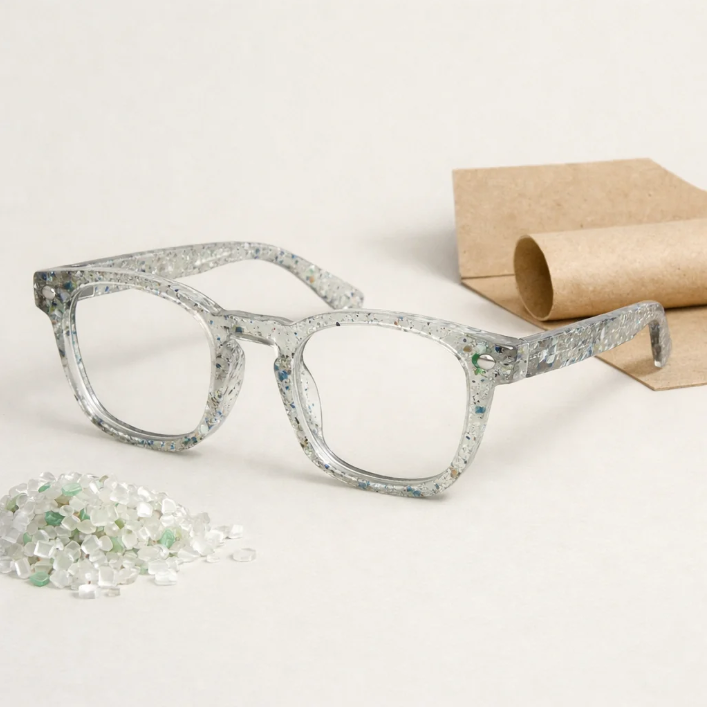
From a material science perspective, acetate is a thermoplastic polymer derived from cotton linters and wood pulp. This composition allows for a unique balance of durability and flexibility, making it a reliable choice for opticians. They often rely on the material’s ability to be adjusted through heat application to create a custom, secure fit that prevents the frames from sliding down the nose. Proper fit is crucial for progressive lens wearers, as any slippage alters the height of the lens, potentially pushing the near-vision segment out of the optimal line of sight.
JHEYEWEAR offers a diverse range of acetate optical frames designed to meet these exact structural requirements, providing practitioners with reliable solutions for complex prescriptions.
Thermal Stability and Daily Performance
Environmental factors, such as temperature fluctuations, can influence the physical characteristics of eyewear materials. Some plastics become brittle in the cold or overly pliable in the heat, which can lead to loosening and subsequent frame misalignment. Acetate exhibits favorable thermal stability, maintaining its structural properties across a wide range of climates. By resisting significant expansion or contraction, the material ensures that the optical center remains stable, preserving the intended performance of the progressive lens design.
Furthermore, because acetate is hypoallergenic and resistant to various environmental stressors like oils and sweat, it provides a stable interface between the lens and the wearer’s face. This stability prevents the common issues associated with frame degradation, such as pitting or loss of structural support, which could otherwise shift the positioning of the lenses.
Achieving success with progressive lens prescriptions involves more than just the lens design itself; it requires a stable, precisely fitted frame. Through the use of durable and temperature-resistant materials like cellulose acetate, practitioners can ensure that the delicate alignment of multi-focal zones is preserved throughout the day. By focusing on the structural advantages of these frames, optical professionals can enhance the patient experience and ensure that the corrective properties of their lenses are consistently delivered as intended.